


Just as I thought of working with developers in a marketing capacity as the new direction for us this year, (ref: Business Times interview),
I looked through my real estate bookmarks on Stumbleupon and re-discovered the7thart.
Gorgeous websites, press releases and conceptualisation. Am loving it.
Check out their amazing portfolio: www.the7thart.com
Below is a photo of the NY Setai- one of the projects in their portfolio.
Real estate marketing


G Hotel

Apparently the 'g' refers to gurney drive in Penang. So this'd be Penang's first modern boutique hotel!
Abducted by agents!

Our tongue in cheek (anti) press release for our new tongue in cheek service.
It's a real service that simultaneously serves as our social commentary on the real estate industry. References to the Situationist International which would explain the otherwise bizarre quotations.
New team photo

Photo link from we make money not art.
Have been sporadically thinking about a team photo- the current chess picture just doesn't cut it for that specific purpose.
Was thinking of something very clean- blue jeans and white t-shirt sort of thing.
Or a bad imitation of trainspotting.
Then I saw the above photo of the fabrica team via wmma's website.
Looks cool(although I still like the trainspotting idea...)
Asymmetry
Ever since Rei Kawakubo joined the dots between architecture and fashion, allowing asymmtery and deconstruction(in the fashion, not the ct sense) to be seen as 'fashionable', asymmetry has been replicated almost to the point of turning into an unfortunate cliche of 'avant garde fashion'.
To reverse the order of influence somewhat, Daniel Libeskind has drawn upon this asymmetry and transposed it to the realm of architecture. The result is Reflections at Keppel Bay.
While it's not the first development in Singapore designed by a 'starchitect', this is the first development where the marketing collaterals are centred around the architect.
An arty advertisement in sepia featuring Libeskind and a website that replicates the asymmetry of the buildings has information on the architect and the surrounding neighbourhood and views(but no information that I can find on the floor plans).
Where the hospitality and real estate industries meet

It's been done before- Ian Schrager's 40 Bond, the Four Seasons Hotel and St Regis Residences; where leaders in the hospitality industry transpose their winning hospitality formulas into real estate development.
Recently noticed that the Sukhothai and the Beaufort groups have come together on 'Beaufort on Nassim'. I happen to love both groups, especially the former. My imagination has been captured, especially by the garden residences. While the concept of water feature in place of the balcony isn't new(there's a condominium in the East Coast that has built in a feature pool for every ground floor unit)- the lush setting of Nassim, the large outdoor space, duplex nature of the units and luxe fittings- seem to promise a slice of heaven on earth- Singapore-style.
On the wish list: Aman Resorts' residences(although I wouldn't be surprised that's not in the pipeline already).
The new showflat

Had an earlier posting about how predictable showflats have become.
While I have yet to see a showflat populated by Maarten Baas or the other kids at Moooi, this showflat at Scotts Highpark, with its North African leanings, is a decidedly interesting departure from the rest.
The rooms look rather sizeable and that promise of a feature pool or jacuzzi on that unbelievably balcony with a vantage point to the surrounding greenery and black and whites(notice the black and white bungalow in the distance- I reckon that's real too, given the right unit and not a figment of the artist's imagination).
It is my personal belief that the more buoyant a property market becomes, the more sophisticated showflats(and consequently unit design and concepts for development) get. The trend towards larger units is a positive side effect in a booming property market otherwise characterized by en bloc exercises in a bid to create (much) smaller units.
Luxuruious, high end city living ceases to be about tiny, overdesigned spaces but are instead being characterized by a more benign concept of living where large living spaces, surrounding greenery (whilst being conveniently, even surprisingly close to the city centre). Where large units were previously restricted to penthouses within any development, a move towards bucking that trend became increasingly recognizable, with the more egalitarian Grange Residences(units of 2500-2800sqft, curiously lacking in penthouses) and BLVD, where the smallest unit is around 2034sqft.
Fortune Cookie
I've always wanted a spin on fortune cookies. Would be freaky to find a note like that at your next jaunt to a Chinese restaurant. But they don't actually have fortune cookies in Chinese restaurants here, do they?
If you're looking for your next apartment or house (rental or sale) call ....XYZ
I heard television networks were printing their ads on eggs.
En bloc
Form magazine, in their September issue, covered a few large, old apartments, in a spirit of defiance, perhaps, against the onslaught of en bloc sales recently.
I would really like to suggest featuring renovated apartments in buildings that have already been slated for en bloc. I know there's at least one cool, well renovated apartment in Habitat 1(also Habitat II- but of course, the demolition of the Habitat condominiums is no less a travesty), a cool unit in Grange Tower, one in Lucky Tower and of course, Futura's in danger too...
the Biennale(again)
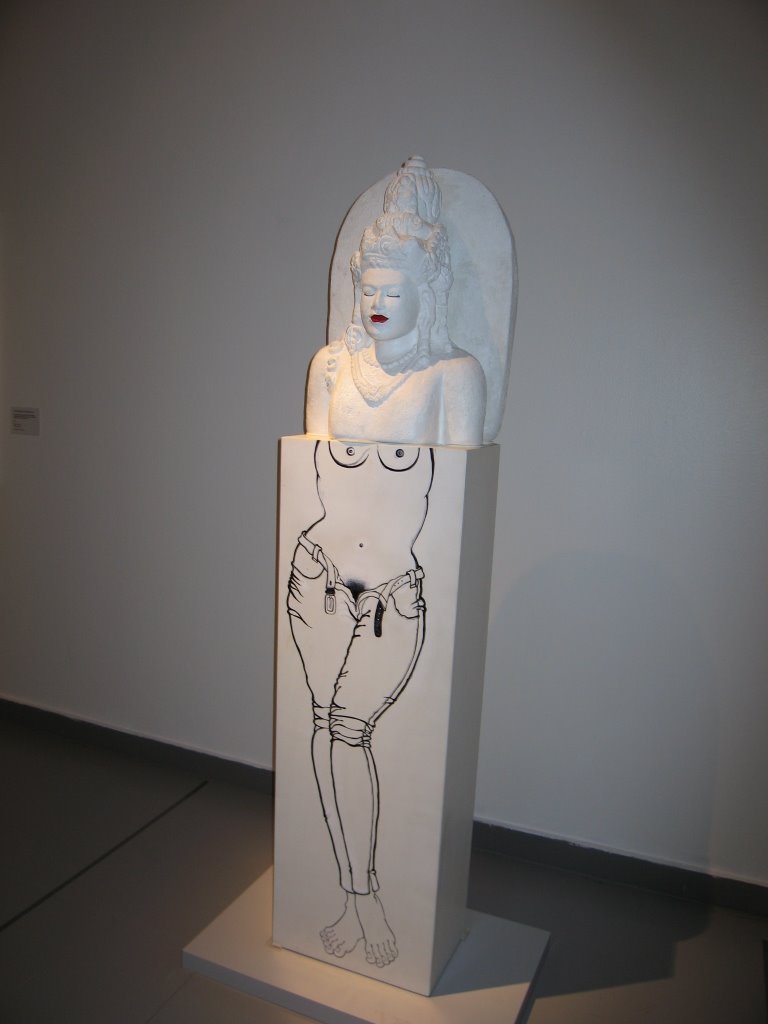
Went to the biennale at the singapore art museum- there were a lot of different, ongoing exhibitions co-existing within the same space in the museum i thought. There was Zaha Hadid's 'All the Best' and 'Telah terbit' co-existing within the same space and I had a difficult time figuring which bit was actually the biennale(especially between the 'Telah Terbit' and the Biennale).
The picture above was from 'Telah Terbit'- I cant remember which artist it was by but i loved the piece! The merging of goddess and whore? I can just imagine it in the dining area of some really sleek modern apartment(the disgustingly hip, clinical combination of open concept stainless steel kitchen and white marble everyting else)
I (heart) this blog- Urban Spaces I Urban Places
From here:
Palimpsest
Frank A. Mills
In the last post, "Rain, Poems, and Alleyways: Framing Space," we looked at framing space through cognitive perception. Last week, while wandering about Buffalo, Wyoming, population 4290, another framing tool, palimpsest, made itself evident. Palimpsest, strictly speaking, refers to parchment that has been written on, erased, and then written on again, with some part of the original writing still remaining legible, although covered over. By extension, then, palimpsest is a place, object, or area that reflects layers of history. Founded in 1879 Buffalo offers serves up a cornucopia of palimpsest. While much of it is rather easy to discover, a substantial portion is hidden in the town's nooks and crannies, best explored on foot. Buffalo, being a small, compact town, that is what I did early Saturday morning for several hours.
As I wandered about, letting my senses lead as they would, I was constantly reminded of the town's history, although not in a preserved sense. Yes, there was the prerequisite museum, but most of the reminder was "layers written over"— layers of faded, peeling painted advertisements and store names on building walls, an almost unrecognizable railroad station, sans track, converted into a home, an alleyway to nowhere disappearing into an angling crevice, even a Rexall Drugstore sign hanging over the doorway of what was soon to become merely a soda fountain cum gift shop. There was the Occidental Hotel (founded in a tent in 1789, the same year that Buffalo was founded) where Owen Wister's Virginian finally got his man (if you ask, the proprietress will show you the room where Wister wrote). Still a hotel, but much different than it once was with its back-door brothel. The door, and its narrow steps to the second floor are still there; the brothel is not. Look over the door and there are still traces of its previous purpose. On the front, if one looks closely, the faded names of the old first floor stores are still legible, now a hotel restaurant and bar. All in all, contemporary Buffalo is an interesting mix of evolved restoration with little historic preservation (the most notable preservation effort is nearby Fort McKinney, three miles to the west). The Occidental Hotel is the perfect example of a building's evolution, not covering over the past entirely, but building over the years in a way that allows the building to evolve with the environment while leaving the palimpsest legible.
Today, in our urban cores and neighborhoods, palimpsest is in danger of becoming irrevocably lost. Those of you who are regular readers of Urban Spaces | Urban Places are well aware of my insistence that for urban revitalization to be sustainable, it must flow from the history of the place. Yet, as new development comes into place, we are rapidly losing all sense of palimpsest, and in my opinion, our urban cores and neighborhoods are none the better for it.
There is, fortunately, a new breed of urban planners on the threshold; different to the point of calling themselves "Radical Urban Planners." Neither New Urbanists or Modernists, Radical Urban Planners range over a broad spectrum of planning philosophies and disciplines. However, one discipline that seems to be common to all, is urban psychogeography. Psychogeography, the evolved offspring of the turn of the 19th-century flâneur, or wandersmänner, is a postmodern discipline that studies the "precise laws and specific effects of the geographical environment, consciously organized or not, on the emotions and behaviors of individuals," especially within a geographic context (Guy Debord, "Introduction to a Critique of Urban Geography," Les Lèvres, No. 6, 1955).
The primary tool of psychogeography is the dérive, or drift. Although appropriated by "urban explorers" wandering about urban ruins (and often leaving their graffiti mark) the drift is the primary tool of the psychogeographer. The drift discovers hidden stories within the urban environment by playfully combining all of the senses, including the imagination, with technical analysis to discover both neighborhood narratives – of people, buildings, landscape, and infrastructure – and the core behaviors embedded in them. For psychogeographers, the drift makes plain the palimpsest in a way that assists in understanding how the past evolved creates the present. Psychogeography does not peel off the layers to reveal the past, but rather sees the past in the present. Palimpsest is not the removal of more recent layers to reveal the past, but individual layers legible through later layers.
Psychogeographers understand that palimpsest – as history revealed in the present – is an essential part of the geographical environment, a part that is crucial to understanding both the evolution of the environment and how that evolution affects the behaviors of present day residents. Psychologically, palimpsest provides the necessary sense of connect to the past. A future not rooted in the past is no future at all. New development can uproot the past through total disregard for it. It can rootlessly approximate the past through nostalgic reproduction or preservation. Or it can sink its roots into the past, building new, but allowing the past to be legible. Only the latter can be fully sustainable; not that it will forever remain in its current built form, but in that it is built to evolve with the environment.
Abode of chaos
Read something about Thierry Ehrmann being fined for desecrating his '18th century home in a quiet suburb of Lyon'. Titled the 'Abode of Chaos', the house's exterior is one of black walls, photographs of war and pictures of the likes of George Bush and Osama bin Laden.
There's a petition to sign on his website
to appeal against the ordered cessation of his works- the recent court order fined Ehrmann for 'violating town planning laws' but did not 'demand he restore the walls and facade to their original state'.
Anyway, below is some delicious gossip I found off a blog re: Ehrmann, involving
Thierry Ehrmann,
the Neighbor from Hell
Travelling upstream along the River Saône from Lyon one comes to Fontaines and, a few meters before Paul Bocuse’s famous restaurant, a strange billboard, graffitied with a sinister skull and the words, “Chaos dwells at Saint-Romain.” A few kilometers further along, here finally is the quiet village thus named, Saint-Romain-au-Mont-d’Or. Well, not that quiet, in fact. Because recently Thierry Ehrmann, CEO of the Serveur group and of Artprice.com has set about “deconstructing his property” and turning it into the “Home of Chaos”, a huge work of destruction that is not to everyone’s taste.
The first time I went to the Domaine de la Source, that historic (1) building looked rather different from what we see today. When Thierry Ehrmann bought it with a view to making it both his home and company headquarters, it was a bourgeois manor of some 100,000 square feet, built in the famous golden stone of the Monts d’Or and standing in the privacy of a walled park. But since 2001 this Domaine de la Source has gradually become the Home of Chaos and the walls no longer hide a thing -on the contrary. The scene today is one of desolation, worthy of John Carpenter’s New York 1999. Apocalyptic. On the parking lot a score of charred autos look like wreckage from inner city riots or a terrorist attack. All around, huge meteorites have dug craters while further on a plane has crashed into the garden. But the most spectacular part of all is no doubt the miniature replica of the ruined World Trade Center, a ten-meter sculpture made with 18 tons of steel and 90 tons of concrete. Nearby, ehrmann plans a Berlin Wall that will be transformed into the barrier being put up by Israel in the West Bank.
In places the facade of the house itself has been liquefied, the fine gold stone turned into a muddy lava by a thermal lance. Everywhere you look are metal salamanders and enameled plaques by Ben, esoteric symbols, frescoes, metal beams apparently propping up the brutalized walls. The interior has been transformed too. In Ehrmann’s office, Renaissance paintings and furniture have been replaced by welded metal, rubble walls and cables hanging from the ceiling, making this strategic room look like the headquarters of a secret organization. On the half-collapsed staircases leading to the apartments are strange sculptures and frescoes. The dominant colors, red and black, also play an important role in the symbolism of alchemy. Thus, on the wall of a windowless room called the “Temple of Sex”, a huge portrait of Bin Laden evokes the red work while, on the facing wall, the face of George W. Bush symbolizes the black work. It would be impossible to describe all the details -besides the house keep changing. Anny Brunelle, Nicolas Delprat, Marc Del Piano and Ben are among the artists who have helped Ehrmann on this work in progress so far. Next up is the construction of Rudy Ricciotti and Mathieu Briand’s bunker, which will house the Organe, a contemporary art museum. In the apartments the floors will be replaced by ropes so that residents can walk through the air. The rest rooms will be popened up and chemical toilets fitted. As Ehrmann puts it, “It’s the day after.” The atmosphere is one of post-atomic chaos, post-civil war, something very contemporary, not unlike what you see on the TV news. Ehrmann describes himself as a news addict. He must have noticed how the word “chaos” has become a media catch-all, a way of saying that the horror couldn’t get any worse. That’s why he wanted to give tangible and spectacular form to this slow collapse of a mutating world, in a gigantic installation including all the world’s major events and figures -religious, political and intellectual. And without moralizing. But why in his own home? For practical reasons, sure, but also because looking after a nice little property investment probably doesn’t rock Ehrmann’s world. The man is a gambler. To understand how a millionaire with a Midas touch came to be where he is you have to delve into his biography. His is no smooth business profile. The son of an influential member of Opus Dei, Ehrmann made his first big bucks in the 1980s on the back of telematic Minitel, boxing and a whole host of equally incongruous activities. He makes no secret for his mystical past as a Freemason and alchemy nut. Anyway, in the 1990s he founded Artprice, a company specializing in online information about, well, the price of art. The art world got to talking about him when he sponsored the 1999 Lyon Biennale. Ehrmann is an inveterate orgy man and a bigamist. The whiff of sulfur hangs about his person. Some say he is the Devil. And so the shadow of Beelzebub also appears on one painted wall, while upside-down portraits of the twentieth century’s greatest thinkers on the facade add another degree of Satanism. (It is even said Ehrmann had Monseigneur Delorme perform an exorcism on him.) Our modern Satan is building (or unbuilding)a contemporary Inferno in a little village outside Lyon. Stone by Stone. The original neighbor from hell, at least for many locals. The mayor of Saint-Romain has done everything in his power to thwart this “architectural sacrilege” but in vain. A member of the governing party (the UMP) even suggested a special law to bring artworks within the range of urban planning regulations. But he withdrew it. Because this is, officially, a work of art: Ehrmann is registered with France’s Maison des Artistes and deposited the idea for his “Demeure du Chaos” in 1999, before he started work. A man with a legal training, he loves to find loopholes in the law and drive a truck through them. The big debate is whether he’s a real artist or just a slightly crazy millionaire à la Howard Hughes. Both, no doubt. His madness is of the variety that can take you a long way. An example: at a perfectly serious board meeting (members include LVMH CEO Bernard Arnault), screened the film of a performance (2) in which, with bailiffs threatening to slap possession order on his property, he slashes himself with a scalpel. “It’s your madness that I’m buying” said one delighted stockholder when it was over. Against all expectations, the Demeure and the personality of its owner are good for business. So much madness, that uncertainly defined territory that Ehrmann knows well, he who spent several years with the status of “incapable adult”.” As for the “artist” label, it’s not very important. After all, artists with weird lives and minds are no novelty since Art Brut came along. Anyway, the Demeure du Chaos is unique, a kind of post-9/11 version of the Postman Cheval’s “Ideal Palace.” (3) It now attracts a very mixed bag of visitors, from the curious to mystics, graffiti artists and nuns come to pray. Some seven hundred people turn up every weekend, sometimes returning home with a little bit of black stone as a relic. The Demeure du Chaos looks set to run and run.
Translation, C. Penwarden
Information:
www.demeureduchaos.com
www.abodeofchaos.org
(1) Gallo-romain ruins were found here. The site was also home to a priory and post house.
(2) Viewable on ehrmann.org
(3) This elaborate construction wich fascinated the Surrealists is just a little further south, at Hauterives.-TRANS.
Richard Leydier
copyright ©2005 artpress
Odell
Ok- I promised that photos of the Singapore Biennale(City Hall edition) would be up- manana. Well, the manana has not arrived- I uploaded my photos today and they were blurred and out of focus- something to do with not being in control of settings in a slightly fancier camera, i'm guessing.
Anyway,was looking up Odell- I know, I heard.
And I found this:-
I remember him mentioning that he was involved wih films in Hong Kong but never did delve further. And I never knew that there was a tribute held for him at the Substation!
I think I must have known the much-mellowed Odell. I never experienced that feeling of being unwanted/unwelcome at the store- although i'm probably blessed in being blissfully unaware of ever being unwanted. I was errant on returning my tapes from the beginning although I always made a note of returning them rewound.
Was never penalised for returning my tapes late.
Never berated for my neophyte tastes in movies- Odell took it upon himself to recommend me an Iranian film(I think he recommended 'Circle of Life')and a French title that I cannot remember.
And we managed small talk about my trip after that weeklong delay in returning his tapes- I completely forgot! and told my brother to return it for me, whom I heard found a common interest with Odell bitching about my habit of renting tapes and then finding no time for them.
Anyway- I've been looking for a few titles recently- Jacques Tati's 'Mon Oncle' and 'The Fountainhead' and I know Odell would have had them
Singapore Biennale
Missed the opening party- and those much talked about projections by Jenny Holzer.
Chanced upon(ok- maybe it was less serendipitous than an aimless wandering) city halls' biennale location.
Will be posting pictures i took- manana...
Keep Walking
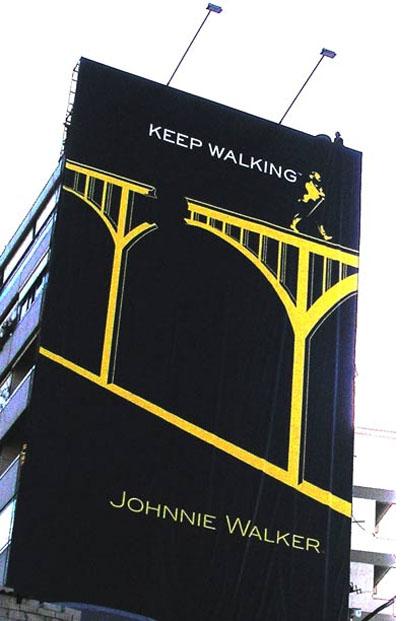
Read an article by Eric Pfanner in the IHT about Johnnie Walker's latest ad campaign in Lebanon. Loved that reference to bombed bridges in Lebanon and how it ties up with Johnnie Walker's 'Keep Walking' tag line.
Got the above photo from Moey's blog- don't you dig that header??
Launch
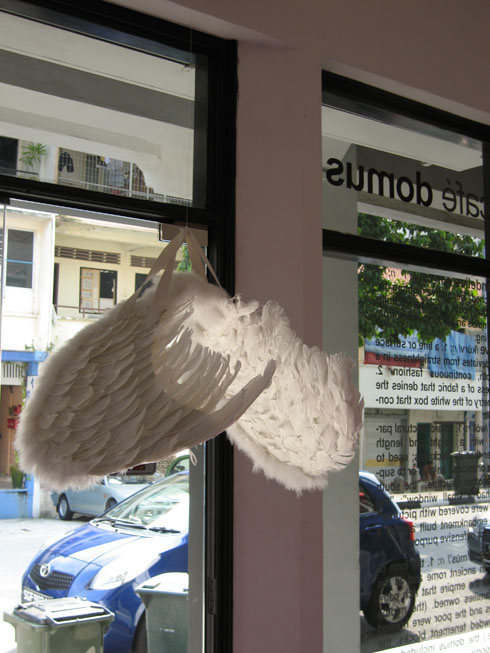
UrbaneSpaces had its launch of 'Gharbzadegi' at Cafe Domus last night.
Was an interesting mix of people- thank you to all those who attended the event!
Big thank you to Yong and all those at Cafe Domus.
Subscribe to:
Posts (Atom)